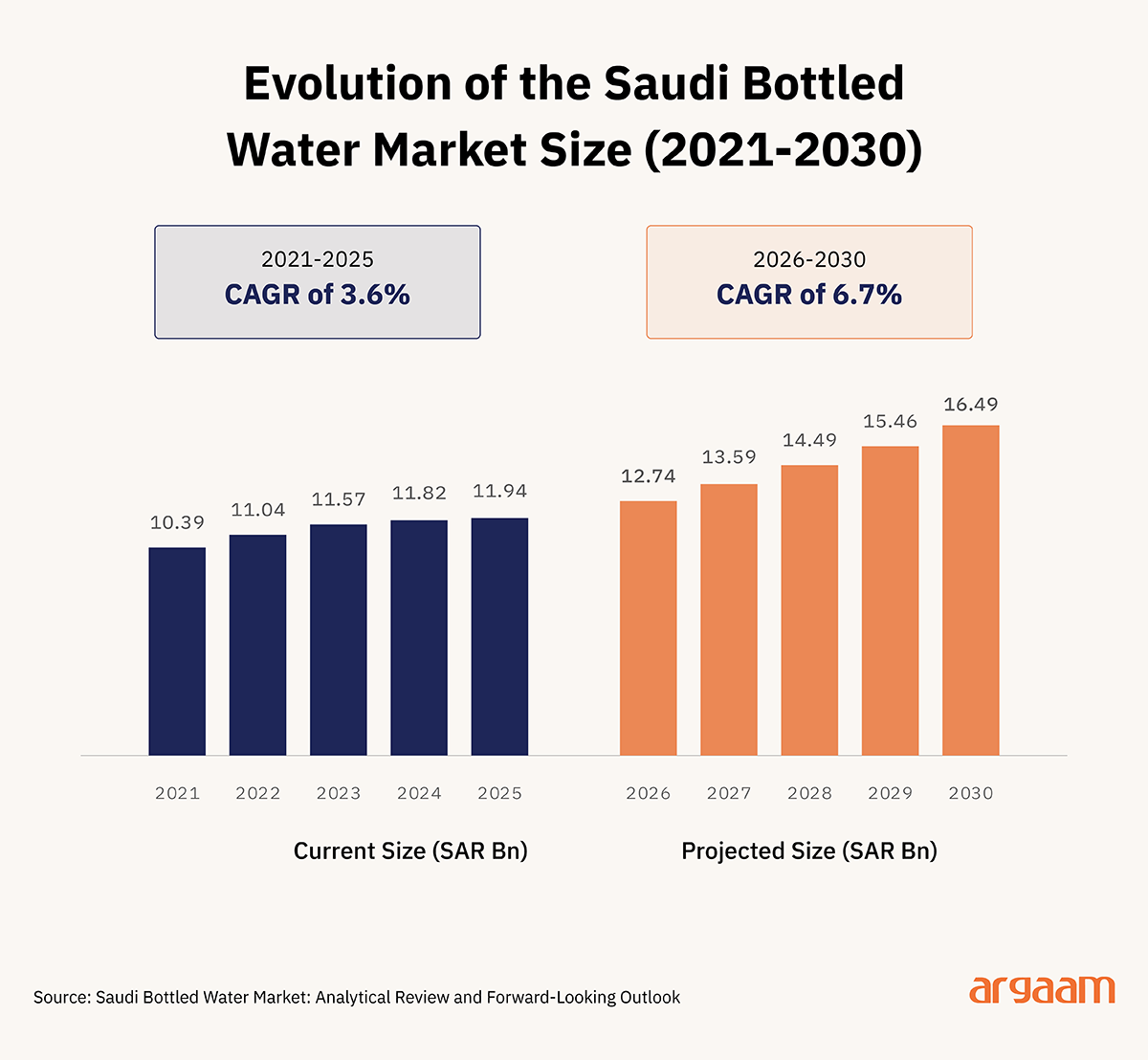
At first glance, the Saudi Bottled Water Market may read like a straightforward growth story. The market size climbed from roughly SAR 10.4 billion in 2021 to nearly SAR 11.9 billion in 2025.
While Argaam’s estimates project that the market size could reach some SAR 16.5 billion by 2030, representing an estimated Compound Annual Growth Rate (GAGR) of around 6.7% over the 2026-2030 period.
Nevertheless, such figures mask a more complex story. Although the market size is expected to expand to approximately SAR 4.6 billion over the next five years, the Saudi Bottled Water Market remains highly competitive, crowded with hundreds of factories and brands, while industry players continually face price and margin pressures.
This friction raises a pivotal question for investors and companies considering expansion: If the market is steadily growing, why is this growth not translating into comparable results for all players? Where do the real opportunities lie within a market that already appears saturated?

The Market Is Growing, but the Benefits Are Not Reaching Everyone
The number of bottled water factories in Saudi Arabia reached 331 in 2024, up from over 200 licensed companies in 2021.
While this surge underscores the market’s robust appeal, it has also intensified competition for market share and distribution channels.
The Porter’s Five Forces analysis prepared by Argaam in collaboration with several industry experts classifies the current level of market competition as “very high”, scoring a maximum 5 out of 5.
Meanwhile, bargaining power of buyers sits at 4 out of 5, driven by the ease with which consumers can switch between brands amid product similarities and the broad spectrum of alternatives.
This intense competition is clearly reflected in prices. The average price of a 1.5-liter bottled water hovered around SAR 2.19 in 2022, before gradually declining to around SAR 2 by year-end 2025.
The Report attributes this downward trend to the growing number of local factories, increased supply, improved production and packaging efficiency, greater automation, and reduced waste.
Consequently, the paradox is therefore clear: demand is robustly expanding, but mounting supply and competition are limiting companies’ ability to translate this growth into corresponding increases in prices or profit margins.
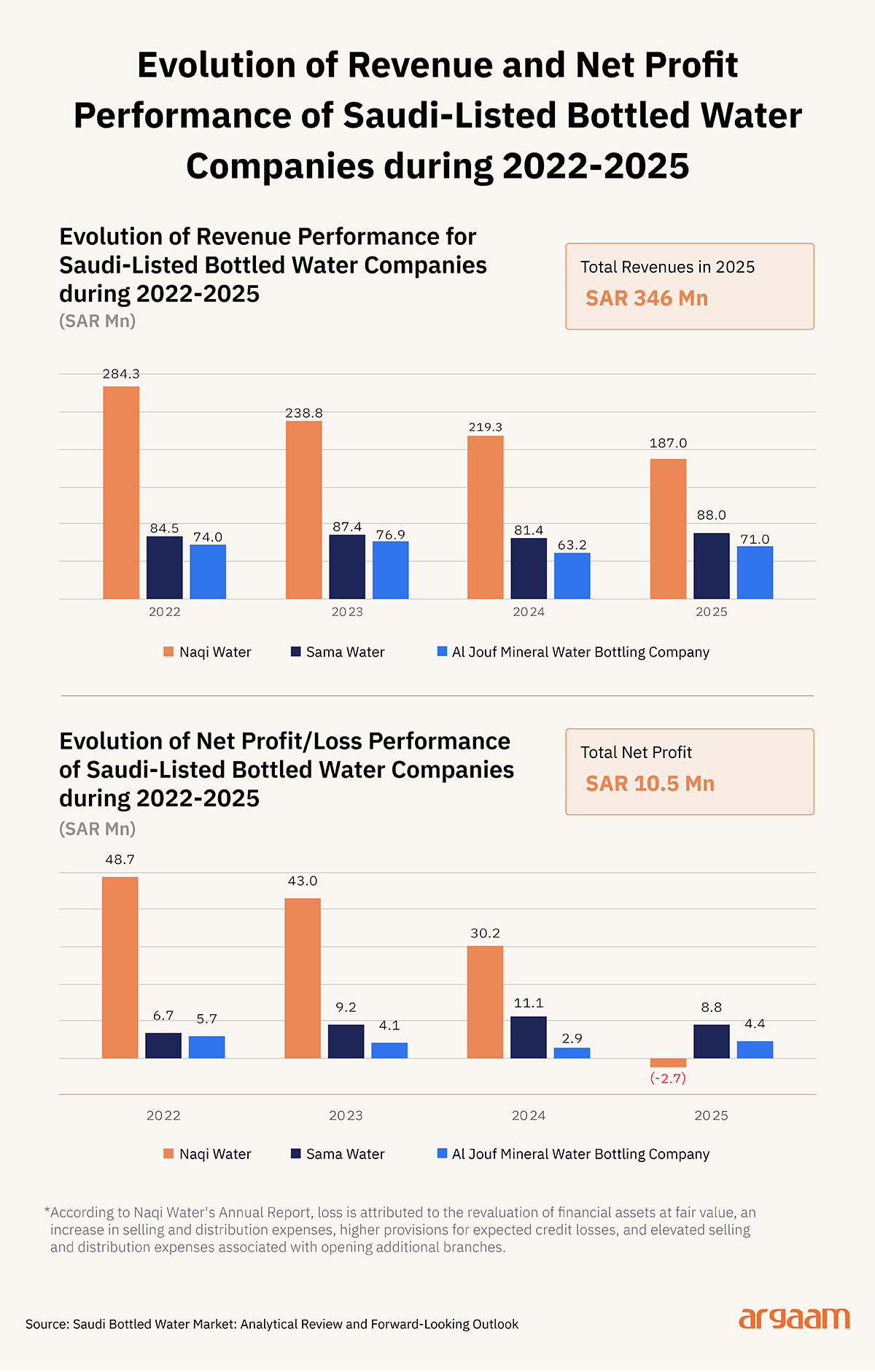
The financial performance of listed companies also paints a similarly mixed picture. Despite market expansion, Naqi Water’s revenue contracted from approximately SAR 284 million in 2022 to SAR 187 million in 2025, culminating a net loss for the most recent financial year.
On the other hand, Al Jouf Water’s revenue experienced a milder revenue decline, whereas Sama achieved modest revenue growth compared to 2022.
Argaam’s study indicates that this divergence reflects not so much a contraction in overall demand as intensified price competition, operational challenges, and varying organizational agility in navigating these challenges.
This leads to an important conclusion: market growth does not necessarily equate to profit growth for all market players.
While the market may expand, the value generated by this growth is distributed unevenly based on each company’s pricing power, distribution capabilities, strategic segment selection, and cost control.

The Issue Is Not Demand Alone
The bottled water industry differs from certain consumer industries where companies can carve out deep differentiation through unique product characteristics.
For a broad segment of the market, particularly the economy and mid-market tiers, products remain relatively similar across brands, granting consumers considerable flexibility to switch between alternatives with ease.
The Report’s consumer survey reveals that taste and water quality rank as the leading factors in choosing among brands, cited by 84% and 77% of the sample, respectively, followed by price at 68%. By contrast, packaging design and colors have a largely secondary role in decision-making.
In other words, growing demand for water alone is not sufficient. Companies must be able to offer acceptably high-quality products at competitive prices, while ensuring seamless availability at the right place and at the right time.
Accordingly, competition extends far beyond merely “producing water” to encompass a broader equation involving operational efficiency, distribution, logistics, and customer access.
Yet, this dynamic does not imply that the market is closed to new opportunities. A more precise reading of the data collected by Argaam indicates that saturation is far from uniform across all market segments.
One Market, but Not One Opportunity
Argaam’s study divided the Saudi Bottled Water Market across seven core dimensions: product type, packaging material, package size, distribution channel, price segment, geographic region, and consumer segments.
This multifaceted analysis changes the perspective, shifting the inquiry from “Does the Saudi market offer investment appeal?” to a more nuanced question: “Which sub-segments continue to offer genuine opportunities for expansion, competitive differentiation, or profitability enhancement?”
Gaps in Package Sizes
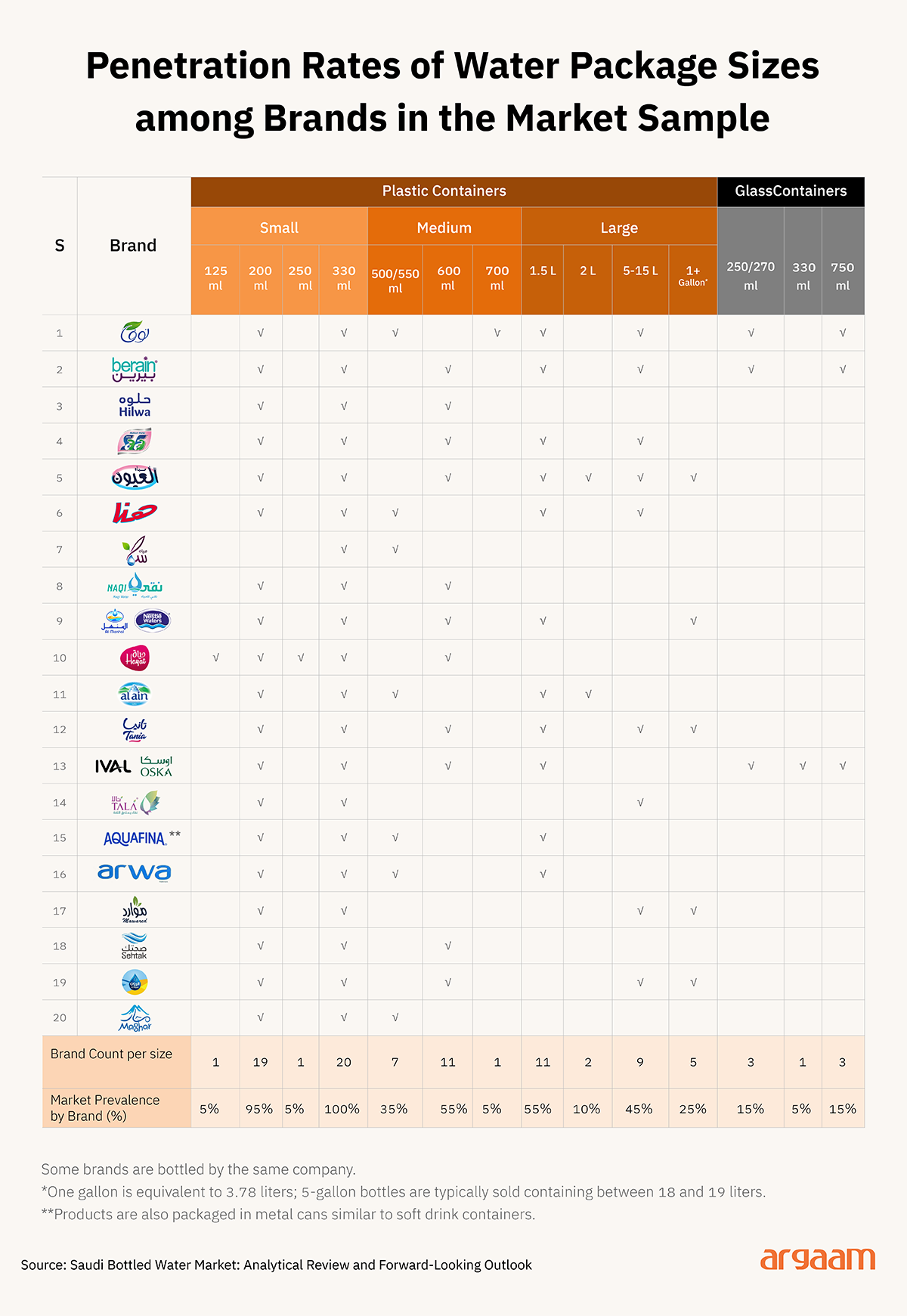
A survey of 20 brands in the market showed that competition is heavily concentrated in traditional sizes. Almost all brands offer a 330 mL package, while the 200 mL package has a penetration rate of 95%.
By contrast, less common sizes, such as 125 mL, 250 mL, and 700 mL, may serve more specialized uses, including schools, events, offices, and certain hospitality activities.
A lower penetration rate for a particular size does not necessarily indicate a confirmed opportunity, as limited penetration may result from weak demand.
However, it does point to an area warranting further study, particularly when the package is associated with a clear use case or a specific consumer segment.
Business and Hospitality Sectors: More Stable Demand
Hotels, restaurants, cafés, and business channels represent some of the most attractive segments within the market. These channels typically rely on long-term supply contracts, with buyers prioritizing supply continuity, quality, health certification, and adherence to delivery schedules rather than price alone. This makes demand more stable and predictable than in some open retail channels.
The importance of this segment is increasing alongside the growth of tourism and the hospitality sector. The number of inbound tourists to Saudi Arabia reached 29.7 million in 2024, while the data presented in the report indicates that the number of hotels increased from 1,161 in 2023 to 2,847 by the end of 2025.
This growth not only creates additional demand but also changes the demand mix. Tourism and hospitality tend to increase the need for small, easy-to-carry packages, while placing greater emphasis on brand image and presentation quality.

Premium and Functional Products: Moving Beyond Price Competition
Meanwhile, the growth of mineral, premium, and functional water is emerging as a potential means of moving away from direct competition in traditional products.
An Argaam study indicates that these categories can generate relatively higher margins. However, they also require greater investment in marketing, source verification, laboratory testing, and product development.
The competitive equation therefore changes. Rather than competing solely on price and volume, companies compete on the value perceived by consumers, whether through source, composition, health attributes, or sustainability.
Direct Distribution and Subscriptions
The opportunity may lie not only in the product itself but also in how it reaches consumers. An Argaam study expects the wider adoption of e-commerce, delivery services, monthly subscriptions, and family bundles to give an advantage to brands capable of combining strong logistics infrastructure with direct consumer relationships.
This shift is important because, in principle, it enables companies to build more continuous customer relationships, improve demand forecasting, and reduce complete reliance on retail shelves and intermediaries.
Where Is Value Concentrated?
When these indicators are considered together, they present a somewhat different picture from the market’s initial impression.
Traditional packages and broad retail channels provide significant volume, but they also involve intense price competition. As for the business and hospitality sectors, they may provide more stable demand.
Premium and functional products offer greater room for differentiation, although they require different investments and marketing approaches.
Meanwhile, e-commerce and subscriptions provide an opportunity to build a business model based on a more direct and recurring relationship with the customer.
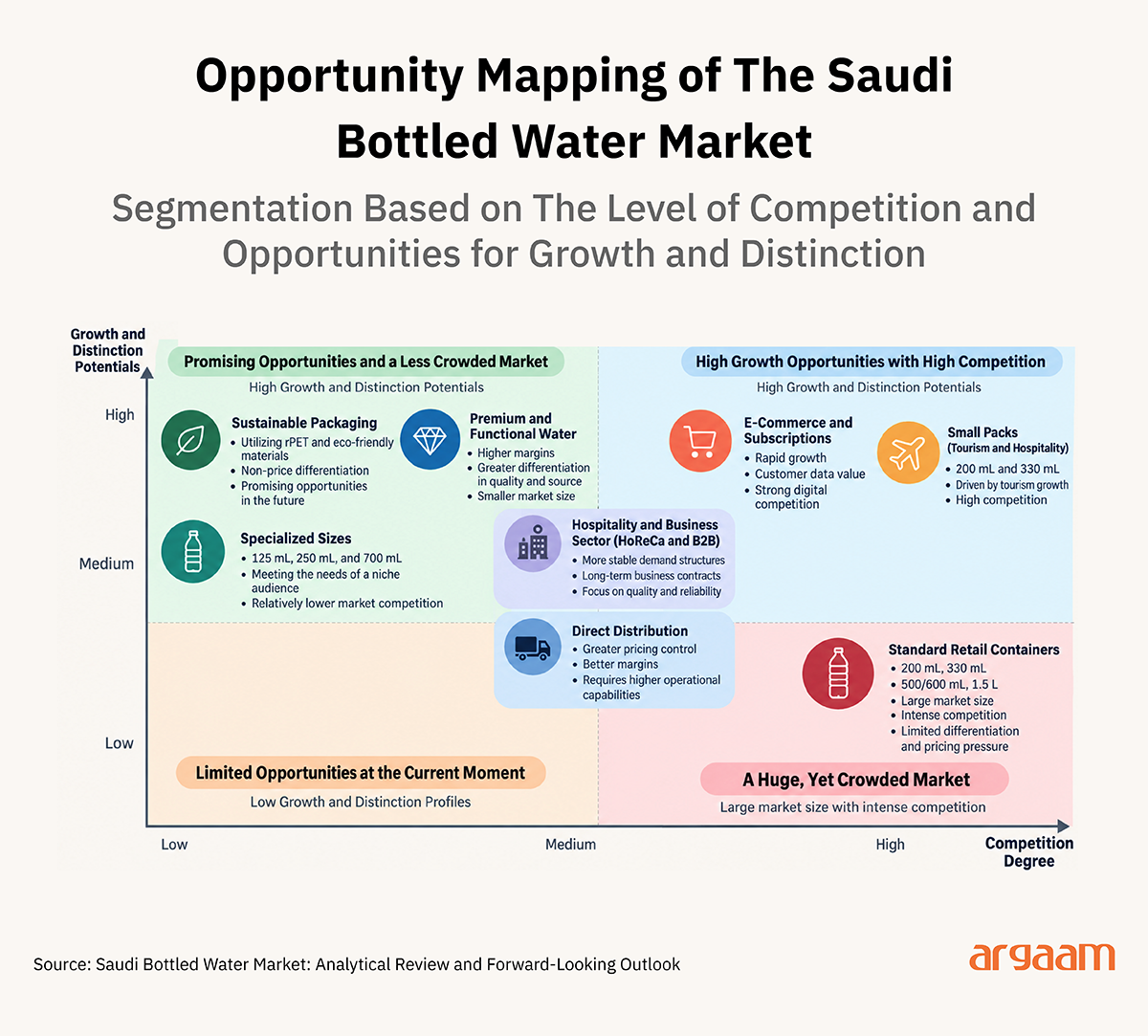
Accordingly, the most important question in the coming years may not be how many new factories the market needs, but rather which business model, segment, and distribution channel can capture the most valuable share of the expected growth.
➤ The Next Phase: From Capacity Expansion to Value Enhancement
The report expects the sector to attract further investment in automation, smart manufacturing, artificial intelligence, demand forecasting, sustainable packaging, the use of materials such as rPET, and the development of value-added products.
Competition may therefore gradually shift from a race to increase production capacity to a race centered on operational efficiency, customer access, specialization, and the ability to convert data and demand into repeat sales and sustainable margins.
The SAR 16.5 billion that the market could reach by 2030 represents a clear growth opportunity for the industry, but it does not, on its own, guarantee similar outcomes for every company operating in the sector.
The story of Saudi Arabia’s bottled water market in the coming years will not be defined solely by the scale of demand growth, but also by companies’ ability to select the right market segment and convert this growth into sustainable economic value.
This article draws on several findings from “The Bottled Water Market in Saudi Arabia: Analytical Review and Forward-Looking Outlook,” published by “Argaam.”
The study provides broader coverage of market size and forecasts through 2030, the competitive landscape, consumer behavior, distribution channels, companies operating in the sector, demand drivers, and future opportunities and challenges.
|